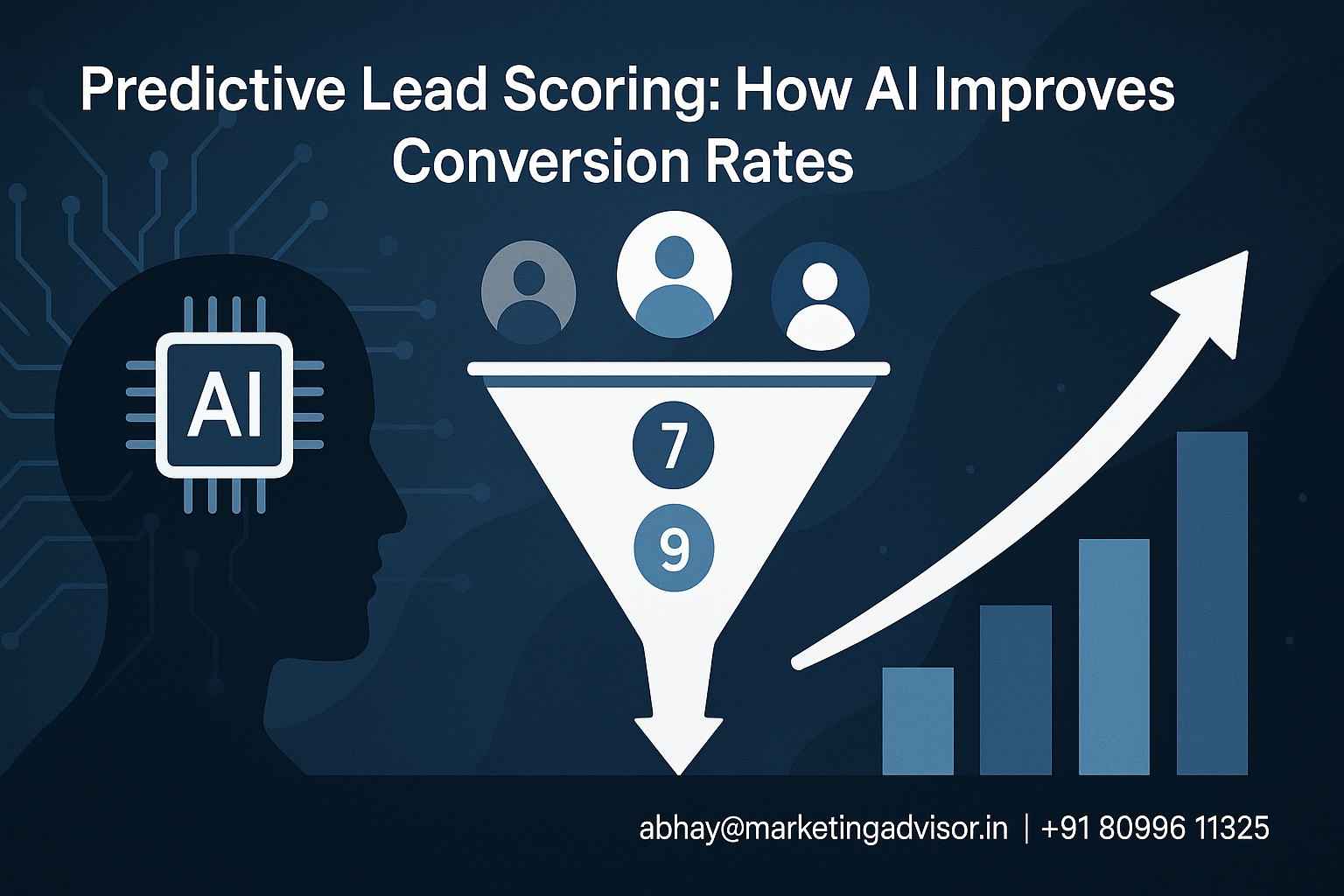
Predictive Lead Scoring: How AI Improves Conversion Rates
Introduction
Predictive lead scoring uses machine learning to sift through customer data and identify prospects most likely to convert. With 61% of marketers saying lead generation is their top priority, leveraging AI to prioritize leads is becoming essential (HubSpot). Industry reports and case studies show predictive approaches can boost conversion rates by double-digit percentages and reduce customer acquisition costs by up to a third. McKinsey research also highlights that personalization and insight-driven marketing can increase revenue by 5–15% while lowering marketing costs by 10–30%. In short: AI-driven scoring turns large volumes of noisy leads into a high-intent pipeline that sales teams can act on.
How Predictive Lead Scoring Works
Data sources and signals
Predictive models draw on many behavioral and firmographic signals, including:
- Web activity: page views, product pages visited, session duration
- Engagement: email opens, clicks, content downloads, webinar attendance
- Firmographics: company size, industry, revenue, location
- Technographics: products or platforms used
- Third-party intent data: search behavior, content consumption on publisher sites
Modeling and features
Machine learning models transform raw signals into features (e.g., recency of activity, frequency of downloads, velocity of engagement). Common approaches:
- Logistic regression or tree-based models for interpretability
- Gradient boosting or random forests for higher accuracy on structured data
- Neural nets for text or sequence data (chat transcripts, long behavioral sequences)
Models are trained on historical outcome labels (closed-won vs. lost) and continuously retrained as patterns change. The result: a numeric lead score that predicts conversion likelihood.
Benefits: Why Predictive Scoring Improves Conversions
Prioritization increases close rates
By focusing on high-intent prospects, sales teams spend effort where it matters. Industry benchmarks and vendor case studies commonly report:
- Conversion rate uplifts of 20–50% among prioritized leads
- Reduction in lead-to-opportunity time by 30% or more
- Lower cost-per-acquisition as fewer low-propensity leads are pursued
Better personalization and timing
Predictive scoring helps deliver the right content at the right time. McKinsey finds that effective personalization can increase revenues by 5–15% and reduce marketing costs by 10–30%, illustrating why scoring-driven personalization moves the needle.
Improved Sales-Marketing alignment
Scoring creates a single, objective metric to define Marketing Qualified Leads (MQLs). Companies that adopt score-based handoffs often report faster lead response times—an important factor given that leads contacted within an hour are far more likely to convert.
Practical Implementation Steps
Step 1: Audit and collect the right data
Start with CRM, marketing automation, website analytics, and any third-party intent providers. Clean, de-duped data produces the most reliable scores.
Step 2: Choose the right model and features
Select models that balance accuracy and explainability for your organization. Include time-based features (recency, frequency, velocity) and use feature importance to validate business logic.
Step 3: Integrate and operationalize
Push scores into CRM and build routing rules:
- Score thresholds to trigger sales outreach
- Automated nurture for mid- and low-score leads
- Sales enablement notes summarizing why a lead scored highly
Step 4: Measure and iterate
Track metrics such as conversion rate by score band, average deal size, and CAC. A/B test routing thresholds and messaging. Continuous retraining prevents model decay.
Mini Case Insight
A mid-sized B2B SaaS firm implemented predictive lead scoring and observed a 28% increase in lead-to-opportunity conversion within six months. They combined web behavioral signals with firmographic data and set a high-intent threshold that routed leads directly to SDRs. As follow-up, targeted nurturing for medium-score leads produced a 35% lift in engagement, demonstrating the dual benefit of prioritization plus tailored nurturing.
Common Challenges and How to Overcome Them
- Data quality: Invest in deduplication, standardization, and enrichment to improve model inputs.
- Model explainability: Use feature importance and simple models where team trust is low.
- Change management: Align sales and marketing on score definitions and SLAs to ensure adoption.
- Privacy and compliance: Ensure data usage complies with GDPR, CCPA, and platform policies.
Best Practices
- Use a hybrid approach: combine rule-based filters with model-driven scores for safety and speed.
- Continuously monitor model performance with holdout samples and real-world outcomes.
- Define clear score bands and associated actions (e.g., hot: immediate outreach; warm: nurture).
- Enrich leads with intent data—buyers who exhibit active search behavior are often 2–3x more likely to convert.
Conclusion
Predictive lead scoring is no longer a novelty—it’s a competitive requirement for teams that need to convert more with less effort. Backed by machine learning, real-time signals, and continuous optimization, predictive models help marketers and sales teams prioritize high-intent prospects, personalize outreach, and improve conversion rates. When implemented with clean data, clear SLAs, and iterative measurement, organizations can see measurable uplifts in pipeline efficiency, reduced CAC, and stronger revenue outcomes.
FAQs
1. What is the difference between traditional lead scoring and predictive lead scoring?
Traditional scoring relies on static rules (e.g., +10 points for job title), while predictive scoring uses machine learning to weigh many features and predict conversion probability based on historical outcomes. Predictive scoring adapts as buyer behavior shifts.
2. How much data do I need to build an effective predictive model?
You need a representative set of past leads with outcome labels (won/lost). While larger datasets increase model stability, even a few thousand labeled leads can yield valuable models if features are informative. Data quality matters more than raw volume.
3. Which metrics should I track to evaluate scoring performance?
Key metrics include conversion rate by score band, precision/recall on a validation set, lead-to-opportunity time, average deal size, and CAC. Monitor lift versus previous non-scoring baselines.
4. Can small businesses benefit from predictive lead scoring?
Yes—small businesses can use simpler models or third-party predictive scoring tools. Many SaaS vendors offer turnkey scoring that integrates with popular CRMs, providing ROI without heavy engineering effort.
5. How often should I retrain my model?
Retrain whenever the business sees material shifts in buyer behavior—commonly every 1–3 months. Real-time retraining can be useful for high-velocity pipelines.
6. What role does intent data play in scoring?
Intent data (search queries, content consumption) signals active buying interest and can significantly improve model precision. Studies indicate buyers exhibiting intent behaviors can be 2–3x more likely to convert.
7. Is predictive scoring compatible with GDPR and CCPA?
Yes, if implemented with privacy in mind. Use consented data, honor opt-outs, minimize PII where possible, and document processing activities to comply with regulations.
8. How do I get sales buy-in for predictive scoring?
Share transparent model results, involve sales in feature selection, set clear SLAs for high-score leads, and run a pilot demonstrating uplift in conversion and time-to-contact metrics.
References
HubSpot – State of Marketing
McKinsey – The value of getting personalization right
Statista – AI in Marketing
Gartner – Marketing and Customer Insights