
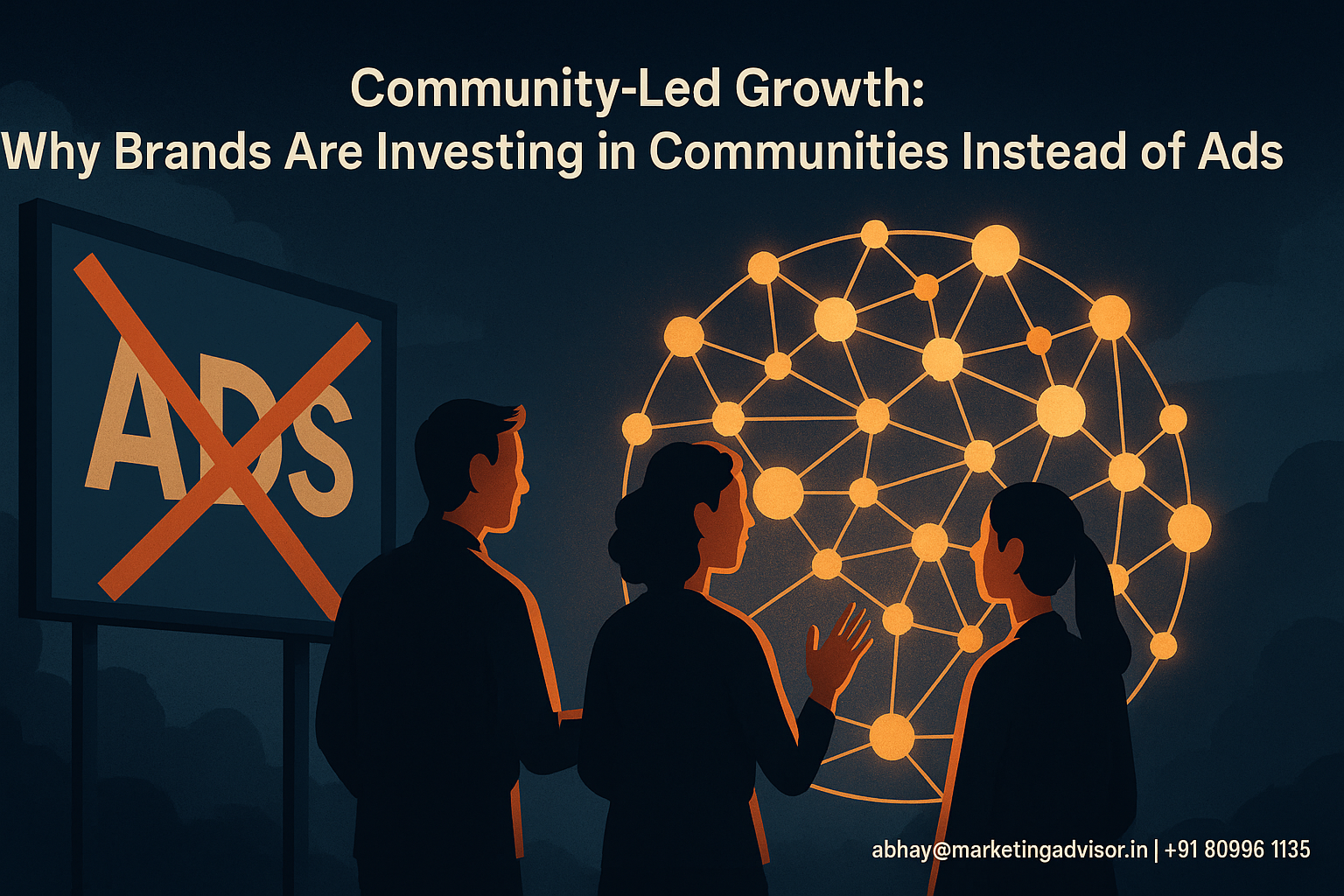
Community-Led Growth: Why Brands Are Investing in Communities Instead of Ads
Introduction
Community-led growth is reshaping how brands acquire customers, boost engagement, and generate advocacy. As paid acquisition costs climb and consumer trust in advertising declines, businesses are turning to communities to build sustainable, lower-cost growth. Key data points underline this shift: Nielsen reports 92% of consumers trust recommendations from people they know over ads; BrightEdge finds organic search drives roughly 50%+ of trackable website traffic (making community content SEO fuel); Meta reported 1.8 billion people use Facebook Groups monthly; and global social platform reach now exceeds 5 billion users (DataReportal). These trends make community investment not just optional—it’s strategic.
Why Communities Matter for Growth
Acquisition: Community as a Low-Cost, High-Trust Channel
Communities shorten the path from discovery to purchase by leveraging peer trust and earned visibility.
- Trust advantage: Nielsen’s finding that 92% of consumers trust recommendations from people they know means members’ referrals convert better than ad-driven traffic.
- Organic reach and SEO: User-generated content and community pages produce long-tail keywords and backlinks—BrightEdge research shows organic search remains the largest source of trackable website traffic, so community content amplifies discoverability.
- Lower CAC via referrals: Members refer friends and colleagues, reducing customer acquisition cost (CAC) compared with paid channels and increasing conversion rates through social proof.
Mini case insight: LEGO Ideas turned fan contributions into product launches, creating a discovery funnel where engaged hobbyists become paying customers and brand ambassadors—reducing paid acquisition needs while creating product-market fit.
Engagement: Deeper Relationships, Richer Data
Communities are living feedback loops. They provide continuous insights, nurture habitual use, and increase time-on-brand interactions.
- Product feedback at scale: Communities accelerate iteration—brands receive direct product insights and can test features with power users before wide release.
- Higher retention: Engaged community members often exhibit higher loyalty and lifetime value because of emotional and social ties to the brand.
- Cost savings in support: Peer-to-peer support in communities lowers support ticket volume and improves resolution speed.
Example: Software companies that host active user forums often see faster onboarding and fewer support escalations because experienced users share solutions, lowering operational costs.
Advocacy: Turning Members into Promoters
Communities create authentic brand advocates who generate word-of-mouth—arguably the most trusted form of marketing.
- Amplified reach: Advocates share product wins and content across social channels, increasing organic impressions and referral traffic.
- Credibility multiplier: Peer recommendations often outperform paid ads in conversion and retention because they’re perceived as unbiased.
- Event and content co-creation: Communities contribute to content pipelines—user stories, reviews, tutorials—that drive SEO and social proof.
Mini case insight: Beauty brands like Sephora cultivate strong community ecosystems (forums, events, and loyalty programs) that feed content, reviews, and social shares—boosting advocacy and repeat purchases.
Designing a Community that Drives Growth
1. Define clear objectives and KPIs
Set measurable goals: acquisition rate from community referrals, engagement metrics (DAU/MAU, posts per member), retention lift, and incremental revenue attributable to community activity.
2. Choose the right platform mix
Select platforms based on where your audience lives and your growth goals:
- Branded forums or in-app communities for product feedback and support
- Facebook Groups for broad social engagement (Meta cites widespread use of groups)
- Discord/Reddit for niche, highly engaged communities
3. Invest in community management and value exchange
Hire or train community managers to catalyze conversation, surface insights, and moderate. Offer clear value—exclusive content, early access, recognition—to motivate participation.
4. Measure and attribute
Use UTM tracking, referral codes, and cohort analysis to attribute acquisition, revenue, and retention to community activities. Tie qualitative insights (sentiment analysis) to quantitative KPIs.
Key Challenges and How to Address Them
Scaling moderation and quality
Challenge: As communities grow, moderation and content quality can suffer.
Solution: Combine volunteer moderators with paid community managers and use content guidelines and automation tools.
Proving short-term ROI
Challenge: Community returns are often long-term and diffuse.
Solution: Start with pilot programs, set short-term engagement KPIs, and use cohort analysis to demonstrate retention lift and referral value within 3–6 months.
Conclusion
Community-led growth is more than a tactic—it’s a strategic shift toward long-term customer relationships, organic acquisition, and authentic advocacy. With rising ad costs and declining ad trust, communities provide a resilient channel that reduces CAC, improves retention, and amplifies word-of-mouth. Brands that invest in purposeful communities—equipped with measurement, management, and member value—will unlock sustainable growth that paid media alone can’t replicate.
Frequently Asked Questions (FAQs)
1. What is community-led growth (CLG)?
Community-led growth is a go-to-market strategy that places a brand’s user community at the center of acquisition, engagement, and advocacy efforts. CLG leverages peer trust, user-generated content, and member referrals to lower acquisition costs and improve retention.
2. How does community-led acquisition compare to paid advertising?
Community-led acquisition typically has lower CAC over time since members refer peers and generate organic content. While paid ads can deliver fast reach, communities deliver high-trust referrals and long-term value through repeat purchases and advocacy.
3. What metrics should I track for community ROI?
Track referral-driven signups, conversion rate of community members vs. non-members, retention rate and churn reduction, engagement metrics (DAU/MAU, posts/comments), and revenue attributable to community cohorts.
4. Which platforms are best for building a brand community?
Choose platforms based on audience behavior: owned forums for control and SEO, Facebook Groups for broad reach, Discord/Reddit for niche and real-time engagement, and in-app communities for product-centric interaction.
5. How long does it take to see results from community investments?
Short-term engagement metrics can show improvements within 1–3 months; measurable impact on acquisition and retention typically becomes clear within 3–12 months, depending on scale and activation.
6. Can small companies benefit from community-led growth?
Yes. Small companies can build tight-knit communities that deliver disproportionate value—early adopters become advocates and co-creators, providing product feedback, referrals, and content.
7. How do you keep community members engaged?
Provide consistent value: exclusive content, recognition, early access, and meaningful conversation. Empower members to contribute, create programs for champions, and ensure active moderation and facilitation.
8. Is community management worth the investment?
Effective community management is essential. Skilled community managers catalyze interactions, maintain quality, and translate member insights into product and marketing improvements—delivering ROI through retention and advocacy.
Leave a Reply