
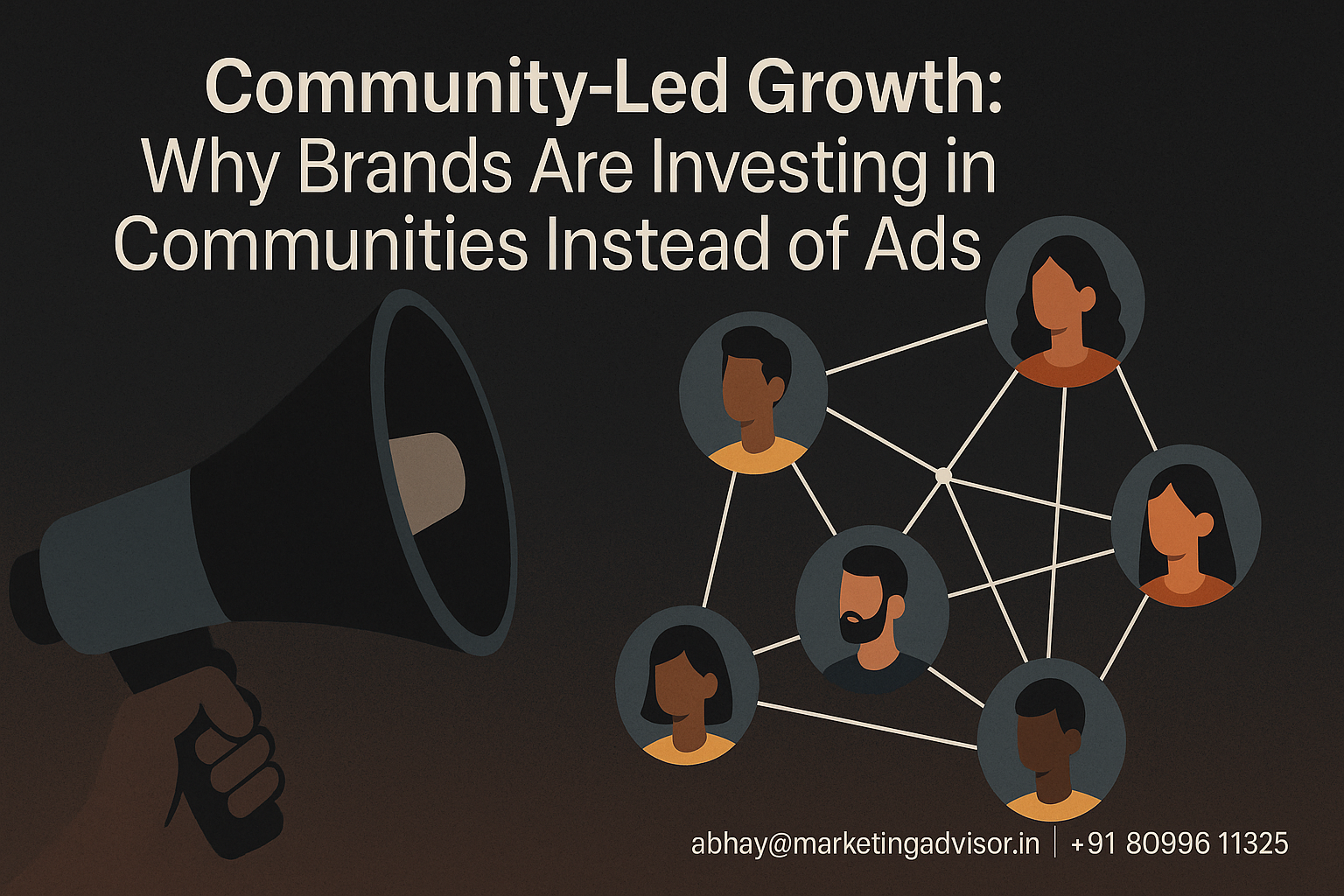
Community-Led Growth: Why Brands Are Investing in Communities Instead of Ads
Introduction
Paid ads remain part of the marketing mix, but many brands are shifting budget and focus to community-led growth. Communities drive acquisition, boost engagement, and create authentic advocacy—often at lower cost and with higher long-term ROI. With roughly 4.7 billion social media users globally and consumers trusting peer recommendations far more than ads, community strategies are becoming a strategic advantage for growth teams.
Why Communities Matter for Growth
Acquisition: Earned reach and higher-quality leads
Communities convert better than cold ad traffic because members discover products through trusted peers and shared experiences.
- Social reach matters: there were about 4.7 billion social network users worldwide in 2023, creating vast potential audiences for community content and referrals. (Statista)
- Trust beats interruption: Nielsen found that recommendations from people you know are among the most trusted forms of advertising—far above display or native ads. (Nielsen)
- Lower CAC over time: members recruited via community channels often cost less to acquire than paid channels when referral loops and organic content scale.
Mini case insight: Glossier and organic acquisition
Beauty brand Glossier used an active customer community and social listening to seed product ideas and collect user-generated content. The result: strong organic reach, high conversion rates from social posts, and a lower reliance on paid ads during early growth stages.
Engagement: Product adoption and retention
Why member activity matters
Engaged community members spend more time with your product, provide feedback, and become first adopters for new features.
- Product adoption: Many community programs report faster product onboarding and higher activation rates when knowledge, tips, and templates are shared peer-to-peer.
- Retention lift: Industry data indicates that community participation is strongly correlated with higher retention—community teams frequently point to meaningful retention uplift tied to active cohorts. (CMX)
- Support deflection: Companies that invest in self-service and community-managed support can reduce direct support costs—Khoros and other platforms cite support cost reductions of up to ~30% through online communities. (Khoros)
Mini case insight: Peloton’s engagement engine
Peloton blends hardware, live classes, leaderboards and social features. The community aspect increases product usage frequency and lowers churn, turning members into repeat purchasers for apparel and subscriptions.
Advocacy: Turning customers into amplifiers
How communities scale word-of-mouth
Communities create authentic advocates who amplify brand messaging across social networks, forums, and in-person experiences.
- Organic amplification: Members create user-generated content that’s typically more trusted and more cost-effective than paid creative.
- Referral velocity: Structured referral programs inside communities can accelerate acquisition—referrals from community members often convert at higher rates.
- Brand ambassadors: Active community members become product experts and informal support reps, reducing friction for newcomers and increasing average lifetime value.
Mini case insight: LEGO Ideas
LEGO’s Ideas platform invites fans to submit and vote on new sets. This co-creation model drives advocacy, product-market fit testing, and strong earned media—proof that communities can be both R&D and marketing channels.
How to Build a Community That Delivers Growth
1. Align community goals with business KPIs
- Define success metrics: acquisition rate from community, support deflection percentage, retention uplift, referral conversion rate.
- Start small with measurable pilots before scaling.
2. Design for value first
- Provide exclusive content, templates, or problem-solving threads that members can’t easily find elsewhere.
- Encourage peer-to-peer help to amplify value and lower support costs.
3. Invest in community management and tooling
- Dedicated community managers increase participation and reduce churn.
- Choose a platform that supports analytics, member segmentation, and integrations with CRM and product data.
4. Incentivize advocacy ethically
- Reward helpful behavior with recognition, badges, early access, or tangible perks.
- Avoid pay-for-post schemes; authenticity is the currency of community.
Measuring the Impact: KPIs to Track
- Acquisition: % of new users who join via community referral or content, CAC by channel
- Engagement: DAU/MAU, time spent, number of posts/comments per member
- Retention/Support: churn rate for community members vs. non-members, support tickets deflected
- Advocacy: referral conversion rate, volume of UGC, net promoter score (NPS) among members
Conclusion
Community-led growth is not a magic bullet, but it is a strategic lever with measurable returns. With global social audiences in the billions and strong consumer trust in peer recommendations, communities can lower acquisition costs, raise engagement, and turn customers into powerful advocates. Brands that invest in thoughtful community programs—backed by clear KPIs and dedicated resources—will capture durable growth that paid ads alone struggle to deliver.
Frequently Asked Questions (FAQs)
1. What is community-led growth (CLG)?
Community-led growth is a GTM approach that uses customer communities to drive acquisition, activation, retention, and advocacy. CLG leverages peer influence, user-generated content, and shared learning to create sustainable, organic growth.
2. How does community-driven acquisition compare to paid advertising?
Community-driven acquisition typically delivers higher-quality leads at lower marginal cost over time because prospects come in with social proof and product familiarity. Ads scale quickly but often require continuous spend to maintain volume; communities compound as members create content and referrals.
3. What resources are required to run a successful community?
Key investments include a community manager (or team), platform/tools, analytics, content and moderation policies, and occasional incentives for members. A pilot period of 6–12 months is usually needed to establish momentum.
4. Which KPIs show community ROI?
Track acquisition sources, conversion rates for community-referred users, engagement metrics (DAU/MAU, posts/replies), retention/churn differentials, support ticket deflection, and referral conversion rates.
5. Can small businesses benefit from communities or is it only for enterprise brands?
Small businesses can benefit hugely—communities can be low-cost, high-impact channels for niche audiences. Start on platforms where your customers already gather (Slack, Discord, Facebook Groups, Reddit) before investing in a bespoke platform.
6. How long before a community impacts revenue?
Short-term benefits like reduced support volume and improved onboarding can appear within months. Full revenue impact—through higher LTV and referral-driven acquisition—usually becomes clear after 9–18 months, depending on product and category.
7. What are common pitfalls to avoid?
Avoid treating community as a pure broadcast channel. Don’t underfund moderation or neglect measuring impact. Also, don’t incentivize low-quality activity—focus on meaningful contributions and authentic relationships.
8. Which platforms work best for community-led growth?
Platform choice depends on audience and goals. Options include:
- Public social platforms: Facebook Groups, Reddit (discovery and scale)
- Chat-based communities: Discord, Slack (real-time engagement)
- Branded forums: Discourse, Vanilla, or in-app communities (ownership and data)
Choose where your customers already congregate and where you can measure impact.
Leave a Reply