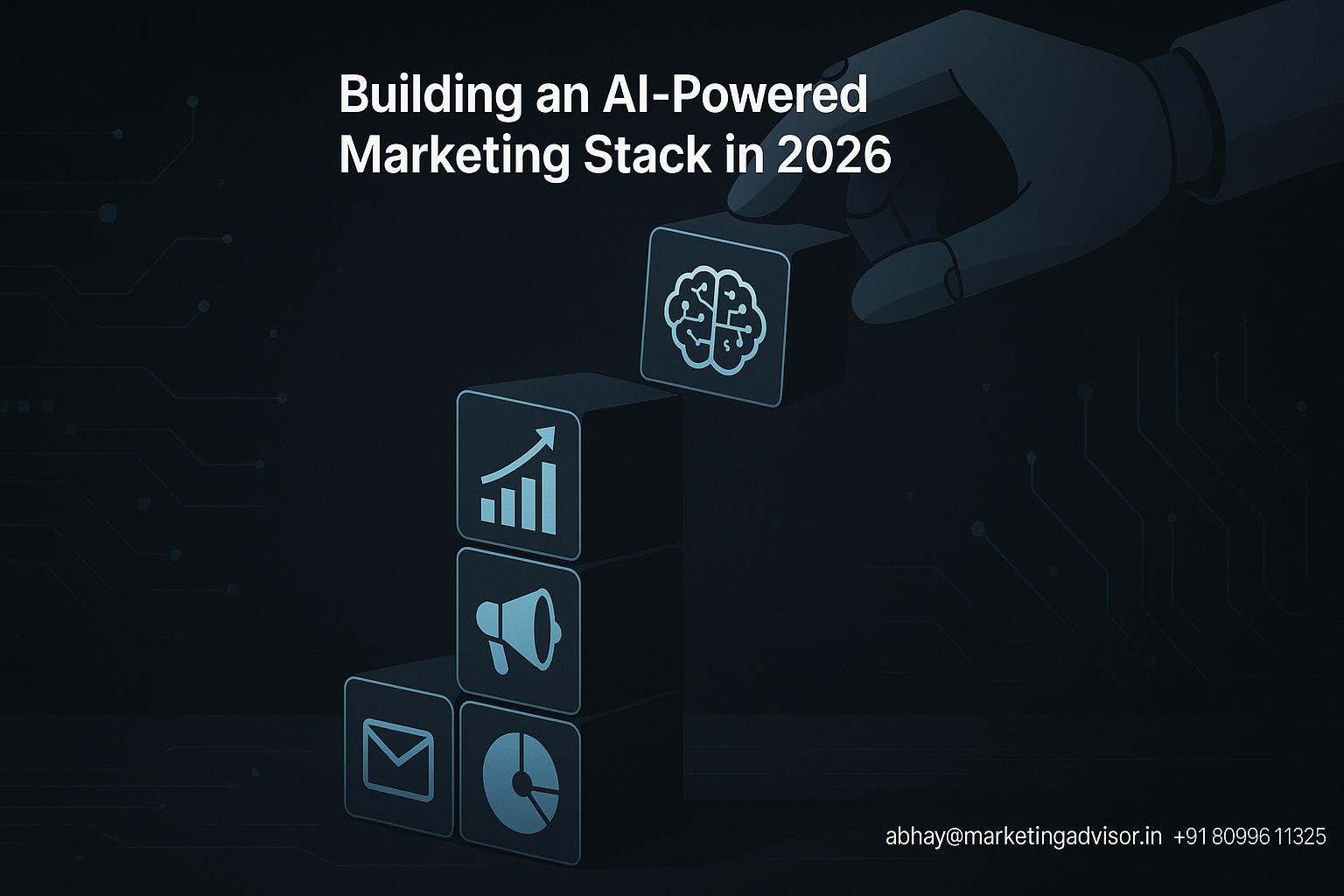
Building an AI-Powered Marketing Stack in 2026
Introduction
AI is no longer an experiment—it’s the backbone of modern marketing stacks. In 2023, 56% of organizations reported using AI in at least one business function, underscoring mainstream adoption (McKinsey). The global AI software market is forecast to surge, reflecting rising investment and capability expansion (Statista). Meanwhile, organic search still drives roughly 50–55% of trackable website traffic—making AI-driven SEO and content tools essential for visibility (BrightEdge). This guide breaks down the must-have AI tools for content, analytics, CRM, advertising, and workflow automation for marketers building a scalable stack in 2026.
Why an AI-Powered Stack Matters
Business impact and benchmarks
- 56% of companies already use AI in at least one function—adoption equals competitive parity (McKinsey).
- Personalization powered by AI can deliver 5–15% revenue uplift and significant ROI improvements when implemented correctly (McKinsey).
- Organic search accounts for roughly half of trackable traffic, so AI tools that improve content relevancy and technical SEO still offer high ROI (BrightEdge).
Core benefits
- Faster content creation and iteration (30–50% time savings reported by teams using generative AI).
- Smarter targeting and budget allocation in ads—AI-driven bidding often boosts conversions by double-digit percentages.
- Automated workflows that reduce manual tasks and decrease time-to-campaign launch.
Core Components of an AI Marketing Stack
1. AI for Content Creation & SEO
- Use generative models (e.g., advanced LLMs) for ideation, first drafts, and multilingual content.
- Pair with SEO intelligence tools (Surfer, Clearscope, Semrush, Ahrefs) to optimize for keywords, search intent, and structured data—organic remains a primary traffic source (BrightEdge).
Mini case insight: An online retailer combined generative content with Surfer optimization and increased organic sessions by 28% in six months while decreasing content production time by 40%.
2. AI-Driven Analytics & Insights
- GA4 + Looker/BigQuery or platforms like Amplitude use ML to surface anomalies and user cohorts automatically.
- Predictive analytics can forecast churn, LTV, and campaign performance—helping allocate budget to channels with the best ROI.
Data point: Companies using AI-driven analytics report quicker detection of performance issues and more accurate forecasting, enabling faster reallocation of 10–20% of marketing spend to higher-performing channels.
3. CRM with Embedded AI
- CRMs like Salesforce (Einstein), HubSpot, and Zoho now include predictive lead scoring, next-best-action recommendations, and AI-assisted outreach.
- Automated personalization at scale improves conversion; personalization use cases have shown 5–15% revenue uplift when matched to the right segments.
4. AI for Advertising
- Platforms such as Google Ads (Performance Max) and Meta Advantage use machine learning for creative selection, bidding, and audience targeting.
- Performance Max and similar automated campaigns often drive incremental conversions—Google reports advertisers seeing meaningful incremental lift when switching to goal-based automated campaigns.
Tip: Use a hybrid approach—let platform automation handle bidding and creative mixing, but retain human control over strategy, audiences, and testing hypotheses.
5. Workflow Automation & Orchestration
- Tools like Zapier, Make (Integromat), Workato, and orchestration within enterprise platforms automate cross-system triggers (e.g., lead -> CRM -> personalization engine -> ad retargeting).
- AI can enhance automation by routing leads based on predicted value and automating content personalization variables at scale.
Implementation Roadmap
Step 1: Audit and prioritize
- Audit current tools, data sources, and gaps (tagging, tracking, customer profiles).
- Prioritize based on potential revenue impact—e.g., personalization first if retention is low; content automation first if acquisition is the bottleneck.
Step 2: Data foundation
- Centralize customer data in a CDP or data warehouse to enable reliable model inputs.
- Ensure privacy and consent management—compliance improves trust and reduces risk.
Step 3: Integrate AI modules
- Start with one use case—automated content + SEO or predictive lead scoring.
- Measure uplift with A/B tests and holdout groups; track KPIs like CAC, LTV, conversion rates, and organic sessions.
Step 4: Scale and govern
- Document model behavior and set guardrails for creative, spend, and personalization thresholds.
- Monitor for bias, data drift, and privacy impacts—retrain models and update consent flows as needed.
Best Practices & Pitfalls to Avoid
- Don’t treat AI as a “set and forget” solution—continuous testing and human oversight are essential.
- Balance automation with human creativity; AI excels at scale and speed but needs strategy and empathy from humans.
- Measure incrementality; use controlled experiments to attribute value correctly.
Conclusion
Building an AI-powered marketing stack in 2026 means combining generative content, predictive analytics, AI-embedded CRM, automated advertising, and workflow orchestration on a strong data foundation. With 56% of organizations already using AI broadly and the global AI market expanding rapidly, marketers who design integrated, measurable stacks will unlock improved efficiency, higher conversion rates, and stronger ROI. Start small, measure rigorously, and scale responsibly.
FAQs
1. What is the single most important first step to build an AI marketing stack?
Start with a data audit and centralization—clean, consented customer data in a CDP or warehouse is essential because AI models depend on high-quality inputs.
2. Which AI tool should I buy first: content generator or predictive analytics?
Choose based on the business bottleneck. If acquisition is slow and organic opportunity exists, prioritize content + SEO tools. If churn or inefficient spend is the issue, start with predictive analytics and CRM scoring.
3. How do I measure ROI from AI marketing tools?
Use controlled experiments (A/B or holdout groups) to measure incremental lift. Track KPIs like CAC, conversion rate, LTV, and organic search traffic. Attribute changes carefully and account for seasonality.
4. Are there privacy or compliance risks with AI in marketing?
Yes. Ensure consent management, data minimization, and compliance with GDPR/CCPA. Maintain transparency on automated decision-making where required.
5. Can small teams benefit from AI stacks or is it only for enterprises?
Small teams can benefit significantly—AI reduces manual work and can amplify limited resources. Cloud-based SaaS AI tools have lowered the barrier to entry.
6. How do I avoid over-reliance on platform automation (e.g., Google, Meta)?
Adopt a hybrid model: leverage platform efficiencies for bidding and creative mixing but maintain control of strategy, audience segmentation, and testing frameworks.
7. How frequently should AI models and automations be reviewed?
Review models monthly for performance and drift; run full audits quarterly. Update workflows after major product/market changes.
8. What skills does a marketing team need in 2026?
Blend of strategy, data literacy, and tooling: marketers who understand data pipelines, experiment design, and creative strategy will lead successful AI adoption.