
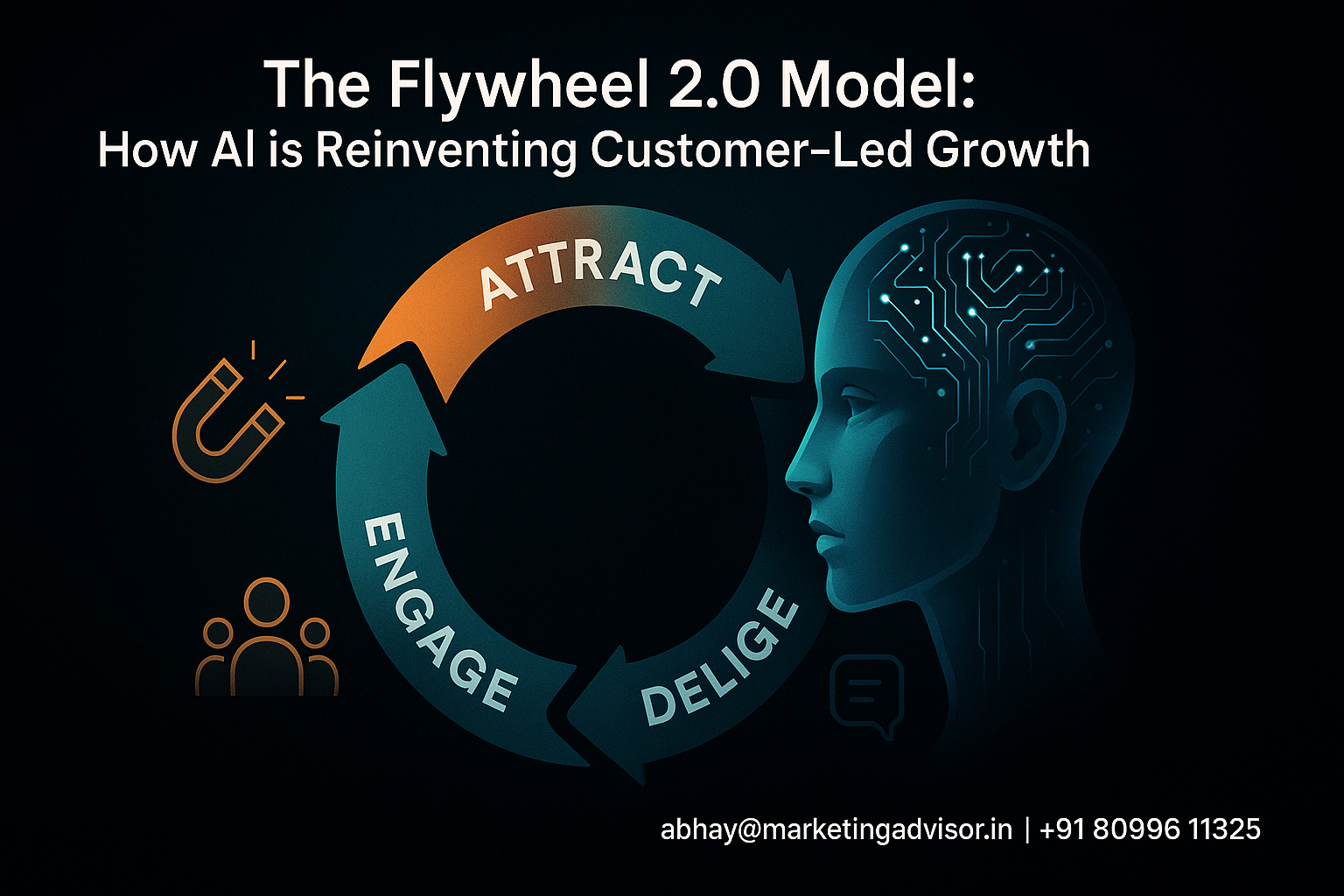
The Flywheel 2.0 Model: How AI is Reinventing Customer-Led Growth
Introduction
AI is transforming the classic flywheel—acquisition, retention, advocacy—into a continuously accelerating engine for customer-led growth. According to McKinsey, personalized approaches driven by AI can boost revenue by 5–15% and cut costs by 10–30%. McKinsey’s surveys also show that over half of organizations have adopted AI in at least one business area, signaling mainstream use. Industry data indicates Amazon’s recommendation engine contributes roughly 35% of its purchases, while Salesforce reports 84% of customers say experience matters as much as product. Combined, these trends make a clear case: AI is no longer optional for growth-minded marketers.
What Is the Flywheel 2.0?
From Funnel to Continuous Momentum
The traditional funnel is linear; the flywheel is cyclical. Flywheel 2.0 embeds AI across each loop—acquisition, retention, advocacy—so data-driven insights continually feed the next stage and increase speed over time.
Core Pillars
- Data orchestration: unify signals across channels (web, mobile, CRM, support).
- Real-time decisioning: apply ML models to deliver instant personalization.
- Automation + human augmentation: automate routine tasks and surface insights for human teams.
How AI Enhances Customer Acquisition
Precision Targeting and Creative Optimization
AI optimizes ad spend and creative by predicting which audiences, messages, and channels will convert best. Programmatic models use lookalike and propensity scoring to reduce CAC.
Key data points:
- Advertisers using AI-driven bidding and targeting often report higher ROI and lower CPCs (industry case studies show CAC reductions in the range of 10–30%).
- McKinsey finds personalization at scale can lift conversion and revenue by 5–15%—a direct acquisition multiplier.
Predictive Lead Scoring and Sales Acceleration
AI-powered lead scoring uses behavioral and firmographic data to rank high-potential prospects, enabling sales teams to focus resources where they matter most. This shortens sales cycles and improves conversion rates.
Mini case insight:
- A B2B SaaS company reduced lead response times by 40% after deploying AI lead-scoring and routing—resulting in a measurable uplift in SQL-to-deal conversion.
How AI Reinforces Customer Retention
Real-Time Personalization and Churn Prediction
Retention is where the flywheel builds momentum. AI tailors content, offers, and product experiences to individual customers and predicts churn before it happens.
Data-backed advantages:
- Companies that implement personalized experiences driven by AI often see retention improvements and customer LTV increases (McKinsey cites 5–15% revenue uplift, which includes gains from retention).
- Chatbots and automated support can reduce service costs by up to 30% while resolving simple queries 24/7 (industry research summarized by Statista and vendor reports).
Dynamic Pricing and Next-Best-Action
AI models can suggest next-best actions (offers, content, interventions) based on a customer’s predicted lifetime value and propensity to engage. Dynamic pricing engines optimize margins while preserving loyalty.
How AI Supercharges Advocacy
Identifying and Amplifying Promoters
AI scans behavioral data, product usage, and sentiment signals to identify likely brand advocates. It then automates NPS follow-ups, referral prompts, and UGC (user-generated content) requests—turning satisfied customers into acquisition channels.
Facts and trends:
- Platforms that systematize advocacy see higher referral-driven growth; for example, recommendation engines (Amazon) account for ~35% of transactions—demonstrating the power of algorithmic advocacy.
- Salesforce reports that customer experience is a major differentiator—satisfied customers are far more likely to recommend brands.
Social Listening and Reputation Management
AI-enabled social listening detects emerging sentiment trends and surfaces crises early. Brands can respond collaboratively and amplify positive stories automatically.
Operationalizing the Flywheel 2.0
Practical Steps to Implement AI Across the Flywheel
- Centralize customer data in a clean CDP/warehouse to create a single customer view.
- Prioritize quick wins: start with predictive lead scoring, personalized email, or chatbot automation.
- Measure lift: A/B test AI-driven interventions and track CAC, churn rate, LTV, and referral conversions.
- Governance: implement model monitoring, ethical guidelines, and privacy-first data practices (GDPR/CCPA compliance).
Technology Stack Considerations
AI success relies on choosing the right mix of:
- Data infrastructure (CDP, DMP, warehouse)
- ML platform or vendor solutions (real-time scoring, recommendation engines)
- Activation channels (ad platforms, email, push, in-app messaging)
Mini Case Insights
Amazon (Recommendation Engine)
Amazon’s recommendation systems are frequently credited with driving roughly 35% of purchases—an example of how discovery and advocacy loops can effectively turn customers into repeat buyers and referrers.
Retail/Beauty Brands (Personalization)
Omnichannel retailers using AI for personalized product recommendations and predictive replenishment have reported measurable lifts in repeat purchase rates and AOV (average order value), consistent with McKinsey’s personalization findings.
Conclusion
Flywheel 2.0 is not a theoretical model—it’s a practical blueprint for continuous, AI-driven customer-led growth. By embedding AI across acquisition, retention, and advocacy, organizations turn data into velocity: lower CAC, higher retention, and more authentic advocacy. With the right data foundation and governance, businesses can unlock the compounding returns of a smart, automated flywheel.
FAQs
1. What is the main difference between the traditional funnel and the AI-driven flywheel?
The funnel is linear; the AI-driven flywheel is cyclical and self-reinforcing. AI augments each loop with real-time personalization, prediction, and automation so customer interactions create data that accelerates subsequent engagement and acquisition.
2. Which AI use-cases deliver the fastest ROI for marketers?
Quick ROI often comes from:
- Personalized email and onsite recommendations
- Predictive lead scoring and routing
- Chatbots for common support tasks
These reduce friction, improve conversions, and lower operational costs.
3. How much can personalization driven by AI improve revenues?
McKinsey estimates personalization at scale can generate a 5–15% revenue uplift and reduce costs 10–30%, though outcomes vary by industry and implementation maturity.
4. Is AI replacing marketers and customer teams?
No—AI automates routine tasks and augments decision-making. Human teams remain critical for strategy, creative, and handling complex customer scenarios.
5. What data governance is needed for Flywheel 2.0?
Implement privacy-first practices, model validation, bias checks, and clear opt-in/opt-out flows aligned with GDPR/CCPA. Regular audits and performance monitoring are essential.
6. Can small businesses benefit from an AI flywheel?
Yes. Many SaaS vendors provide accessible AI capabilities (chatbots, recommendations, email personalization). Small businesses can achieve strong ROI by starting with targeted, high-impact use-cases.
7. How do you measure success for an AI-powered flywheel?
Track metrics across loops: CAC, conversion rate, churn rate, customer lifetime value (LTV), NPS, and referral-driven revenue. Compare AI-driven cohorts vs control groups.
8. What are common pitfalls when implementing AI in the flywheel?
Common pitfalls include poor data quality, unrealistic expectations, lack of governance, and failing to A/B test—each can undermine performance and trust.