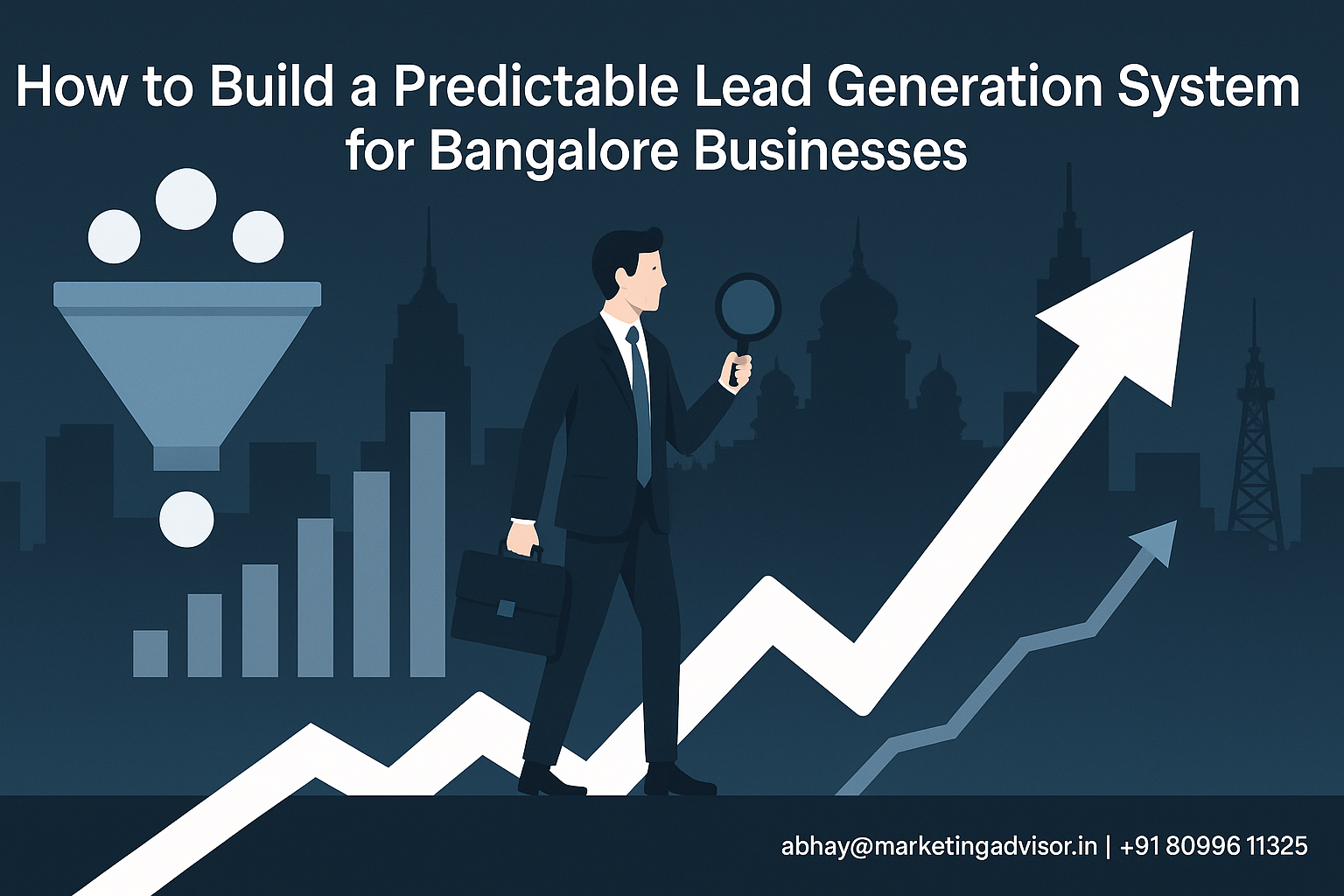
Building a Predictable Lead Generation System for Businesses in Bangalore
Introduction
Bangalore’s fast-growing startup ecosystem and competitive services market demand a predictable, scalable approach to lead generation. Instead of ad-hoc campaigns, businesses that combine SEO, paid advertising, content marketing, and marketing automation can reduce cost-per-lead and improve close rates. According to HubSpot, 61% of marketers say generating traffic and leads is their top challenge, and BrightEdge reports organic search drives roughly 53% of all trackable website traffic—showing why a structured system matters. Additionally, Google found that 53% of mobile users abandon sites that take longer than 3 seconds to load, underscoring the importance of technical SEO and fast user experiences.
Why Move From Random Marketing to a Systematic Approach?
Business risks of ad-hoc marketing
- Inconsistent lead flow and unpredictable revenue.
- Inefficient ad spend due to poor targeting and lack of measurement.
- Difficulty scaling: what works one month often fails the next without documented processes.
Benefits of a predictable system
- Stable pipeline forecasting and better cash-flow planning.
- Higher conversion rates: HubSpot notes inbound leads have a reported close rate of 14.6% vs. 1.7% for outbound—illustrating the long-term ROI of inbound-driven systems.
- Ability to iterate and scale what works using data-driven decisions.
Core Components of a Predictable Lead Generation System
1. SEO: The foundation
- Technical SEO: ensure site speed, mobile responsiveness, and crawlability. (Google: 53% of users abandon slow pages.)
- On-page optimization: target local keywords (e.g., “Bangalore SaaS marketing agency”) and structured content for buyer intent.
- Local SEO: Google Business Profile optimization, local schema, and review management—critical for service businesses in Bangalore.
2. Paid Advertising: Accelerated reach and testing
- Use search ads for high-intent keywords to capture immediate demand.
- Retargeting and lookalike audiences on platforms like Google and Meta help re-engage visitors and reduce CPL (cost per lead).
- Always A/B test ad creatives and landing pages; small CTR/landing page improvements can cut CPL by 20–40%.
3. Content Marketing: Long-term authority and nurturing
- Produce content mapped to each stage of the buyer journey—awareness, consideration, decision.
- Use pillar pages and clusters to boost topical authority—BrightEdge-style data shows organic search remains the largest source of traffic.
- Repurpose long-form content into email sequences, webinars, and social posts to amplify reach.
4. Marketing Automation & Sales Enablement
- Implement a CRM and marketing automation to score leads, trigger nurturing sequences, and alert sales at the optimal moment.
- Use lead scoring to prioritize high-intent prospects; automation can increase qualified leads while reducing manual work.
- Track KPI dashboards (traffic by source, MQL→SQL conversion rates, CPL, LTV:CAC) for continuous optimization.
How to Integrate These Components: A Step-by-Step Playbook
- Audit: start with a 360° audit of SEO, paid accounts, content assets, and funnel metrics.
- Define Ideal Customer Profile (ICP): map content and ad targeting to exactly who buys from you in Bangalore and beyond.
- Build core assets: high-converting landing pages, SEO pillar pages, and a lead magnet (e.g., industry report).
- Set up automation: lead capture flows, scoring, and handoffs to sales with SLAs.
- Test and scale: iterate ad spend on winning channels and double down on content that drives organic growth.
Mini Case Insight: Bangalore SaaS Startup
A Bangalore-based SaaS company moved from sporadic campaigns to a systemized approach. By prioritizing technical SEO, creating three buyer-focused pillar pages, and running targeted search ads, they increased MQLs from 30/month to 300/month within 9 months. Conversion rate from MQL to SQL improved by 42% after implementing lead scoring and an automated nurturing sequence. This highlights how integrated channels plus process changes deliver predictable outcomes.
Scaling Lead Generation with an Experienced Marketing Team
Why partner with an experienced team?
- Faster implementation: experienced teams bring templates, tested playbooks, and vendor relationships.
- Data-driven optimization: mature agencies know benchmark metrics and can quickly identify levers to reduce CPL.
- Cross-discipline coordination: SEO, paid, content, and automation teams working together avoid wasted effort and conflicting messaging.
How a partner helps you scale
- Rapid audits and roadmaps aligned to revenue targets.
- Ongoing experimentation and budget reallocation to high-performing channels.
- Transparent reporting so leadership can forecast and plan growth confidently.
Key Metrics to Track
- Traffic by source (organic, paid, referral)
- Leads per channel and CPL
- MQL → SQL conversion rate
- Time-to-first-response and sales SLAs
- Customer acquisition cost (CAC) and LTV:CAC ratio
Conclusion
For businesses in Bangalore, moving from random marketing activities to a predictable lead generation system is both practical and necessary. By integrating SEO, paid advertising, content marketing, and marketing automation—and by measuring the right KPIs—you can build a system that consistently feeds the sales pipeline and scales. Working with experienced marketing teams speeds implementation, reduces errors, and unlocks sustainable growth.
Frequently Asked Questions (FAQs)
1. How long does it take to see results from an integrated lead generation system?
Most businesses see early wins from paid advertising within weeks, while SEO and content-driven results usually take 3–6 months to show meaningful impact. Full predictability and scale commonly require 6–12 months of iterative optimization.
2. What’s the ideal budget split between SEO, paid ads, and content?
There’s no one-size-fits-all. A common starting split for growth-stage companies is 40% paid ads (short-term demand), 35% content (long-term organic growth), and 25% SEO/technical improvements. Adjust based on channel ROI.
3. Do small businesses in Bangalore need marketing automation?
Yes—automation saves time, improves lead nurturing, and increases conversion consistency. Even small teams benefit from basic workflows and lead scoring to prioritize sales follow-up.
4. Can paid advertising replace SEO?
No. Paid advertising provides instant visibility but stops when the budget ends. SEO builds sustainable, high-intent traffic long-term; combining both yields the best ROI.
5. How do I measure whether my lead generation is predictable?
Predictability is shown by consistent month-over-month lead volumes within an acceptable variance (e.g., ±10–20%) and stable conversion rates from MQL to SQL and beyond.
6. What KPIs should a Bangalore-based B2B company prioritize?
Focus on organic traffic share, MQLs per month, MQL→SQL conversion, CPL, and sales cycle length. Local lead quality (e.g., company size, vertical) also matters.
7. How important is local SEO for Bangalore businesses?
Very important. Many service searches include location modifiers. Optimizing Google Business Profile, collecting reviews, and targeting local keywords can significantly boost local lead generation.
8. When should I hire an external agency vs. build an in-house team?
Hire an agency when you need rapid implementation, specialized skills, and benchmarked processes. Consider in-house when you require deep product knowledge and long-term ownership—many companies use a hybrid model for best results.