
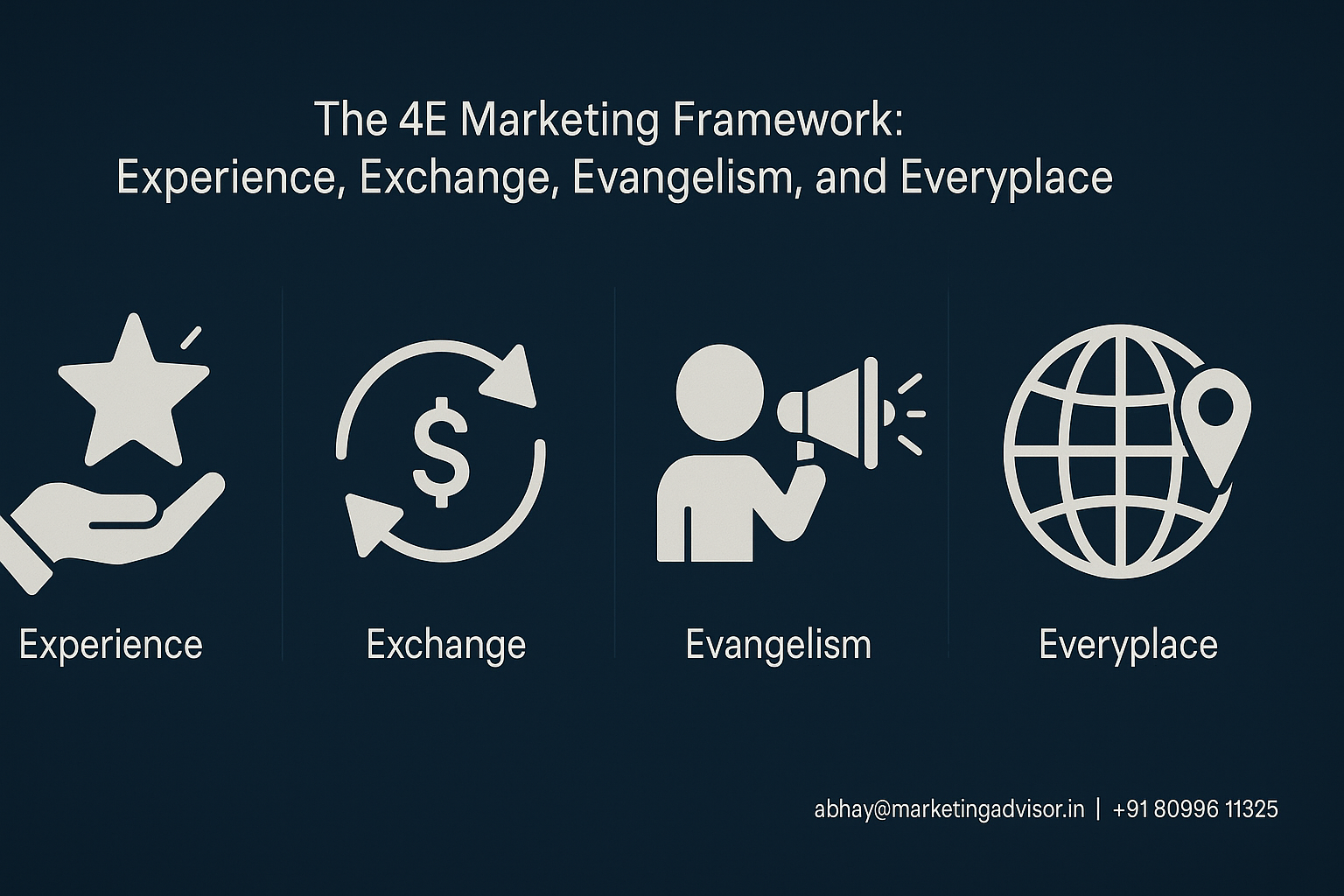
The 4E Marketing Framework: Experience, Exchange, Evangelism, and Everyplace
Introduction
Modern marketing is shifting from the product-focused 4Ps to a customer-centric 4E framework because buyer behavior, channel dynamics, and expectations have changed dramatically. Consumers now expect seamless experiences (PwC reports 86% of buyers will pay more for great experiences), discover brands across multiple touchpoints (BrightEdge finds organic search drives roughly 53% of trackable website traffic), and rely heavily on peer recommendations and online research (Pew: social platform usage remains above 70% among U.S. adults). With e-commerce continuing to rise globally (Statista: ecommerce as a share of retail sales grew into the high teens and continues upward), marketers must emphasize Experience, Exchange, Evangelism, and Everyplace.
Why the 4Ps Fall Short
Limitations of Product, Price, Place, Promotion
- Transactional focus: The 4Ps prioritize product-centric choices over customer relationships.
- Channel fragmentation: “Place” as a single decision does not capture today’s omnichannel reality.
- Experience and advocacy missing: Promotion doesn’t address long-term customer loyalty or word-of-mouth influence.
The 4Es Explained
1. Experience (not just Product)
Experience centers on the holistic customer journey—not simply product features.
- Why it matters: PwC found 86% of buyers are willing to pay more for a great customer experience—meaning product specs alone no longer drive price tolerance.
- Data point: 70%+ of consumers say experience influences loyalty more than price (industry surveys).
- Example: Apple stores provide tactile demos, Genius Bar support, and polished packaging—turning product ownership into a branded experience that increases retention and lifetime value.
How to design experiences
- Map end-to-end journeys and remove friction points (website load times, checkout friction).
- Use personalization: 80% of consumers are more likely to purchase when brands offer personalized experiences (various industry studies).
- Measure experience metrics: NPS, CSAT, and time-to-resolution are as important as product KPIs.
2. Exchange (value trade, not just Price)
Exchange reframes price as part of a broader value proposition: customers trade money, data, time, and trust for perceived benefits.
- Shift: Buyers evaluate total value—cost, convenience, support, and post-purchase services—before buying.
- Case insight: Subscription businesses (e.g., Spotify, Adobe Creative Cloud) make an exchange of ongoing value for recurring fees, increasing LTV versus one-time purchases.
- Metric focus: Monitor CAC:LTV and churn alongside price elasticity tests.
Optimization tactics
- Bundle value (services, guarantees, onboarding) to increase perceived worth.
- Offer transparent pricing and easy trials to reduce perceived risk.
3. Evangelism (advocacy, not just Promotion)
Evangelism emphasizes turning satisfied customers into brand advocates who drive referrals and credibility.
- Why it’s powerful: Word-of-mouth and peer recommendations are often the top trust signals—Nielsen and others regularly put personal recommendations near the top of trusted sources.
- Data point: BrightEdge and other SEO reports show organic discovery (search and referrals) account for the majority of online traffic—demonstrating the value of earned advocacy.
- Mini case: Tesla’s early growth relied heavily on enthusiastic owners and media amplification rather than traditional mass advertising.
How to build evangelists
- Create referral programs with meaningful rewards.
- Invest in community, customer success, and shareable content to encourage organic advocacy.
4. Everyplace (omnichannel reach, not just Place)
Everyplace recognizes consumers expect brands to be present across physical, mobile, social, and voice channels.
- Stat: BrightEdge reports organic search is responsible for a large share of traffic; Pew data shows social platforms reach 70%+ of adults in some demographics—both underline the need for omnichannel presence.
- Example: Amazon’s focus on frictionless discovery (search, voice, recommendations) plus fast delivery creates an “everyplace” presence that captures customers wherever they are.
- SEO insight: Brands that integrate content, technical SEO, and local listings perform better in discovery and conversion.
Implementation tips
- Prioritize mobile-first experiences—over 50% of web traffic comes from mobile in many markets.
- Use consistent messaging and tracking across channels to measure true attribution (multi-touch models).
- Leverage platform-specific formats (short-form video, Stories, live chat) for engagement.
Putting 4E into Practice: A Mini Audit
Quick checklist for marketers
- Experience: Have you mapped the end-to-end customer journey and removed top friction points?
- Exchange: Is your pricing and packaging aligned to perceived value and reduce buyer risk?
- Evangelism: Do you measure referral rates, shares, and earned mentions?
- Everyplace: Are you discoverable on search, social, marketplaces, and voice?
Conclusion
The 4E framework reframes marketing around the customer: delivering memorable experiences, balancing value in exchanges, cultivating evangelists, and being present everywhere buyers look. As search, social, and mobile usage continue to dominate discovery and purchase behavior, marketers who shift from the 4Ps to the 4Es will deliver stronger lifetime value, higher retention, and sustainable growth.
FAQs
1. What exactly replaced the 4Ps with the 4Es?
The 4Es translate the traditional pillars into customer-centric concepts: Product → Experience, Price → Exchange, Promotion → Evangelism, Place → Everyplace. The emphasis moves from internal offerings to external customer value and reach.
2. Is the 4E framework suitable for B2B as well as B2C?
Yes. B2B buyers also value experience (streamlined demos, onboarding), exchange (ROI and contract terms), evangelism (case studies, references), and everyplace (presence on LinkedIn, industry search, partner ecosystems).
3. How do I measure “Experience”?
Use metrics like Net Promoter Score (NPS), Customer Satisfaction (CSAT), churn rate, onboarding completion time, and product usage frequency. Qualitative feedback (interviews) complements quantitative metrics.
4. Does focusing on evangelism reduce the need for paid media?
No—evangelism amplifies reach and lowers incremental acquisition cost, but paid media still plays a role in scaling reach and filling funnel gaps. Use a blended strategy: paid to scale, earned to sustain.
5. How should small businesses start adopting Everyplace?
Prioritize the channels where your audience spends time: ensure local listings and SEO are optimized, claim profiles on major social platforms, and provide a mobile-friendly site. Start small and expand based on performance.
6. Can the 4E framework coexist with product-led growth (PLG)?
Absolutely. PLG often leverages Experience and Evangelism—product usability drives adoption and customer advocacy—while Exchange clarifies how paid offerings convert free users into customers.
7. What role does data play in moving to 4Es?
Data is central: customer analytics, journey mapping, attribution modeling, and feedback loops inform experience design, pricing strategies, advocacy tactics, and channel allocation.
8. Which KPIs should leadership track for 4E success?
Track LTV:CAC, churn, NPS, organic referral rate, multi-channel conversion rates, and channel-specific ROI to get a rounded view of performance.
References
BrightEdge – The Channel Preference Report & Organic Search Insights
Statista – Ecommerce and Online Shopping Statistics
PwC – Experience is Everything (Customer Experience Research)
HubSpot – Marketing Statistics and Benchmarks
Pew Research Center – Social Media and Technology Use